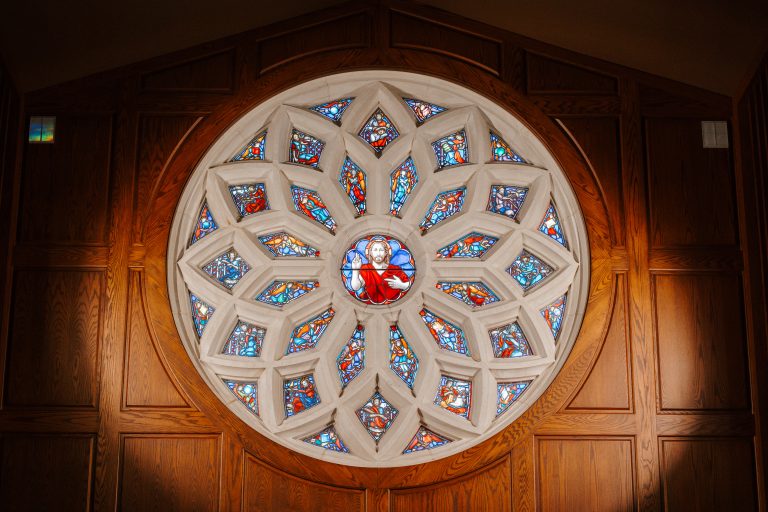
Stained Glass: Rose Window
Rose windows are divided into stained-glass segments by stone mullions and tracery. The term “rose” window was first used in 17th century England. Previously, these windows were called an “oculus,” after the Oculus of the Pantheon in Rome. Rose windows became more ornate through the centuries. In the middle ages, a Gothic rose window was emblematic of a well-ordered soul; its symmetry recalling the perfect unity found in our right relationship with God.
All elements in the window were centered on Christ. Even when the Virgin Mary was depicted at the center, she always holds a Christ child, and every element radiating from that center takes its stable place from its relationship to Christ.
The rose window of this Cathedral uses imagery from Revelation 21:9-20, which speaks of the heavenly Jerusalem, centered on Christ, of which the Twelve Apostles are the foundation. Twelve gemstones adorn the periphery of the window (jasper, sapphire, agate, emerald, onyx, ruby, chrysolite, beryl, topaz, turquoise, jacinth, and amethyst) taken from the same chapter of Revelation.
DONOR